Bomb Squad and Baghdad
In the fourth insight into Julian’s journey, we go back to Iraq in July 2010, nearly a year after his promotion to Global Head of Transaction Banking FX at Standard Chartered. Despite the bank’s limited physical presence in Baghdad, Julian is there to foster key relationships and learn about an American-held bank that was looking to sell. The visit is fraught with danger, culminating in a devastating rocket attack on the U.S. Embassy in the Green Zone, where Julian narrowly escapes death and has to face up to the reality of loss and the mental toll that can take.
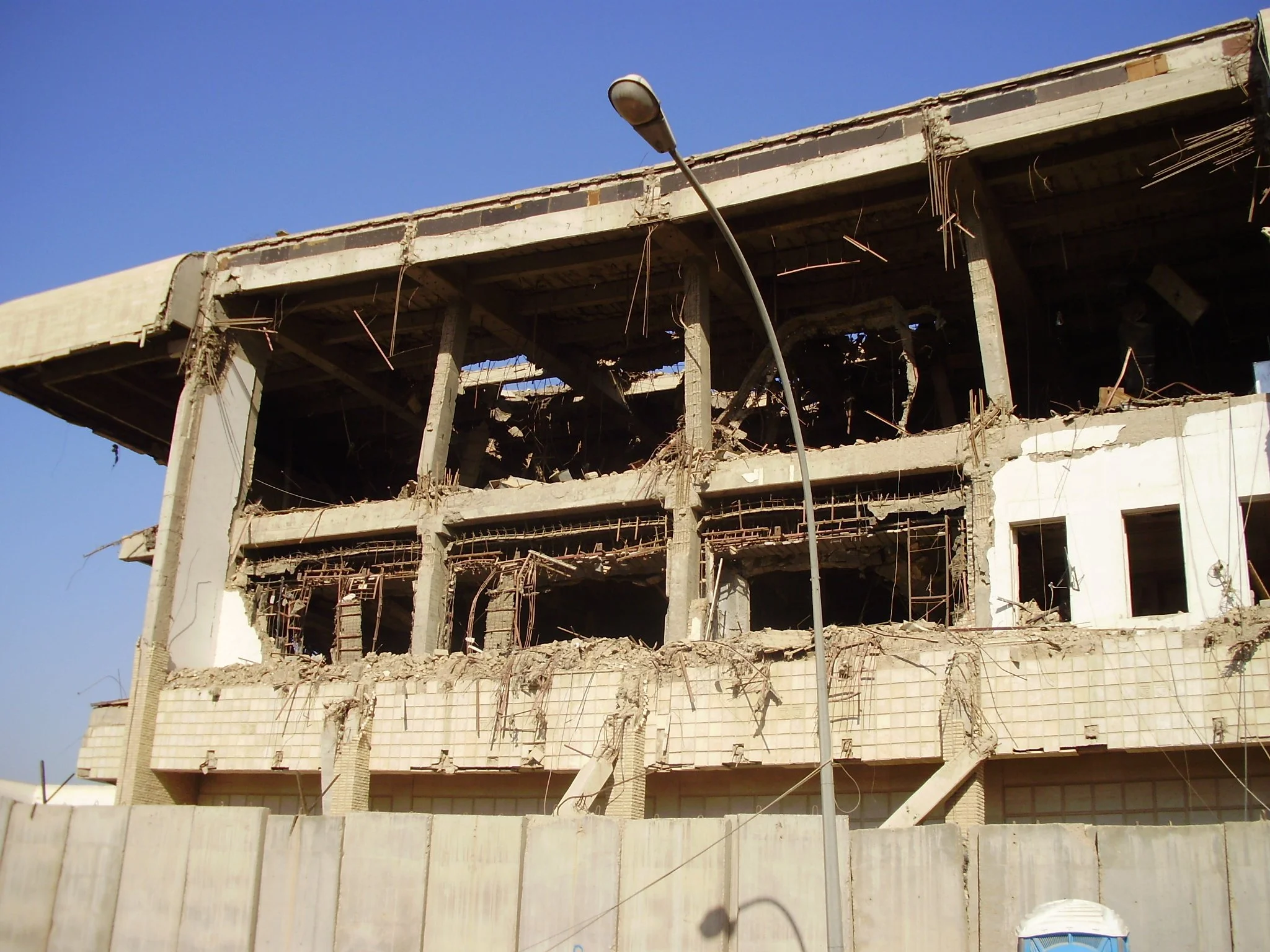
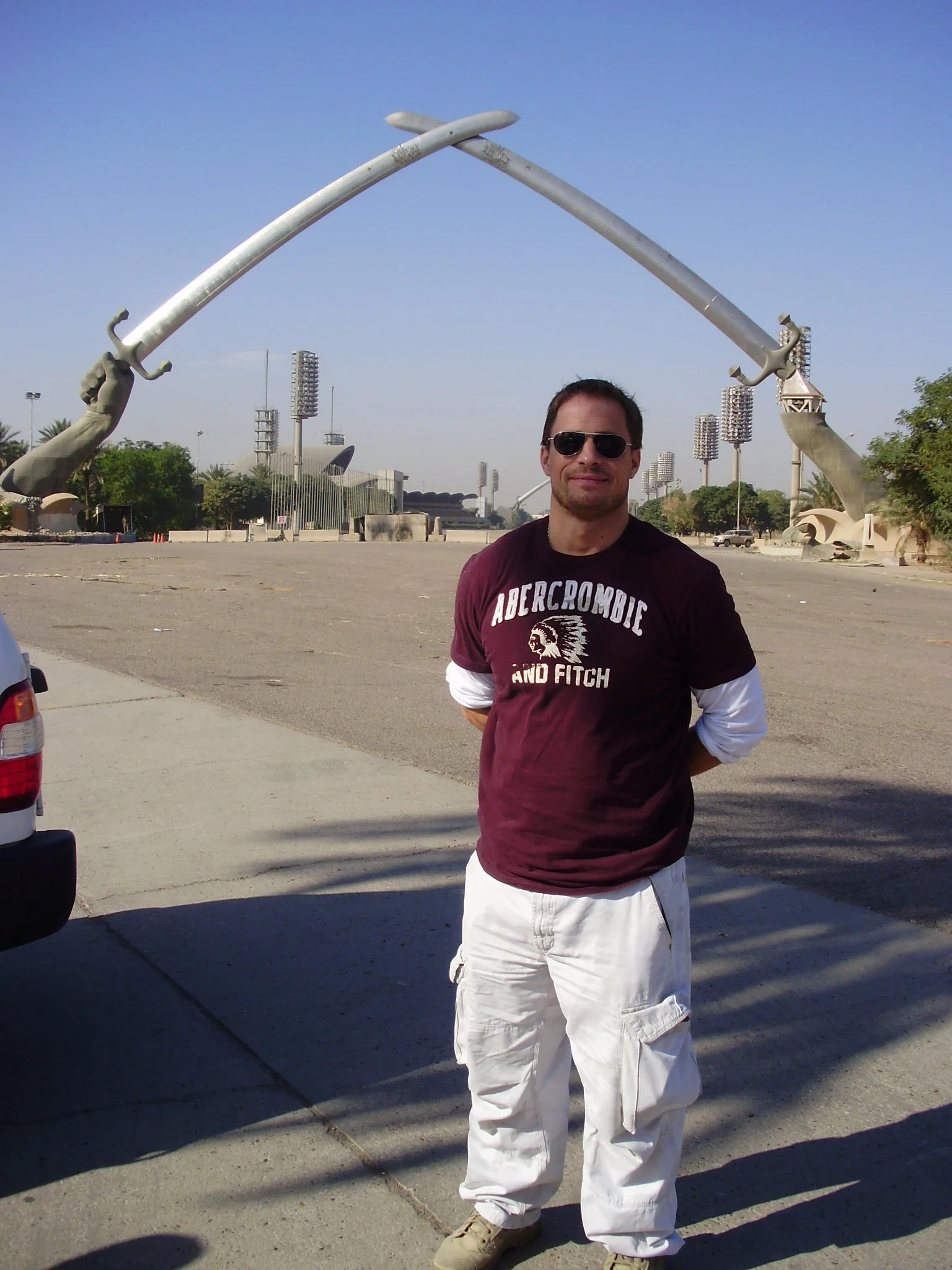
“The day of the attack, I was in the U.S. Embassy. I was working with Sabre Security in the Green Zone in one of the old palaces where the SAS used to base themselves, and this almighty explosion ripped through the building. It was the front of the Embassy being rocketed from a very close-by part of Baghdad. The guys that checked me in, three of them lost their lives then…One of the Americans suffered life-changing injuries…Had I been about half an hour later, I’d have been murdered in that attack. That evening, we got drunk in the mess at Sabre, desperately trying to scrub the horrific experience off. There was a part of me that didn’t want to, though, the last incarnation of these humans, their fingerprints were on my phone; those poor Ugandan guys who’d signed me in. It’s a reality that I think you survive by, you know, trying to forget that that exists. It takes a piece of your soul away. It’s a very numbing experience to witness people being murdered like that. To witness the way life is valued.”
Before Project Green had cast a shadow across Julian’s desk in Dubai. Before the house of cards began to fall. In his new role as Global Head of Transaction Banking FX, with every month that passed by, it became more and more apparent that Standard Chartered wasn’t all it seemed to be.
Julian already knew that this step up on the corporate ladder was undoubtedly influenced by more than his proven ability to navigate the hedge fund and financial landscape. The relationships he had nurtured with key figureheads at the Abu Dhabi Investment Authority had not gone unnoticed.
At the time, Standard Chartered Bank’s operations across Iraq were strategic but limited. With no physical presence in Baghdad, but a representative office in Erbil, Iraqi Kurdistan, the bank was working through relationships that were effectively at arm's length, albeit built upon Standard Chartered’s earlier, deeper ties to Iraq’s financial infrastructure development. Back in 2003, the bank was part of the international consortium (which also included JPMorgan Chase and the National Bank of Kuwait) that helped establish the Trade Bank of Iraq (TBI) following the regime change. It’s purpose? Facilitating international trade and the country’s reconstruction. The very same goal Julian would visit Baghdad under the illusion of.
While lacking an on-the-ground branch in Baghdad c2010 (although one would open later in November 2013), Standard Chartered maintained its network through the TBI, correspondent banking networks, and the Central Bank of Iraq (CBI). As far as Julian was concerned, supporting these relationships was fundamental to his very existence at the bank.
Having experienced a few previous visits to Baghdad on behalf of the bank, these were relatively uneventful, as much as they could be in an area that had been so fraught with conflict. Stepping foot in the city, one had to be very cognizant of the military environment. Second nature to Julian, of course. The skills he honed during the Air Force, however, would once again be called upon during one final visit to Iraq in July 2010. Almost a year into his promotion, Julian walked back into a war zone, and this time, it was burning.
That year had seen the capital heavily impacted by a surge in deadly terrorist attacks alongside major political and security developments, which included the final withdrawal of the last U.S. troops and a contentious parliamentary election. The city felt restless. Unsettled. Baghdad was falling apart.
From the moment his plane touched down at the airport on the outskirts of the city, moving through the terminal, catching glimpses of this dangerous but beautiful landscape, Julian and his fellow travellers were at the mercy of a warlord who would decide if they would gain entry. Ushered through passport control, Julian’s next hurried step saw him grab luggage and body armour, an essential layer for the duration of this stay; Westerners had been frequently taken as hostages or targeted with explosives.
“When I got in the B6 Armoured Shogun at the airport, I loaded both weapons, put one in the chamber (a 7.62 round) and took the safety off so I was ready to shoot. It was such a weird transition back from civilian life. The SAS guy who met me outside passport control greeted me with, ‘Afternoon, sir, good to see you’. He looked at body armour and said, ‘Old habits die hard?’ They were comfortable knowing I was ex-military and knew I could be a trusted member of the bomb squad if needed.
“Driving to the Central Bank, we turned down Thieves Alley, where we briefed our ambush strategy - watching with rear-view mirrors to monitor if anyone had put a magnetic IED on our bumper.
“Exit was very simple.
“Claymore mines would be thrown from both of the front passenger windows, and we would fight through a 90-degree exit with maximum force.”
With this visit spanning ten days, various meetings were booked into Julian’s diary. Each came and went; it was clear there were some very dangerous people embedded in the network. The aim was to learn more about a bank that the Americans were trying to sell and pass on to Standard Chartered to manage. They had no intention of doing so. Their interests were laser-focused on meeting the people who were in control of large swaths of Iraq and Iraqi business.
Julian’s former military experience meant that his hosts, Sabre Security, would happily arm him during this visit. Carrying a small sidearm and a submachine gun, Julian and Sabre - a unit made up of ex-22 SAS D Squadron - travelled in armoured vehicles. With his body armour skewed to the right, Julian wore two ballistic plates in the chest protective piece to accommodate his heart being on the opposite side of his chest due to his situs inversus.
This had been everyday life for Iraqis since 2003. So much so, it had become a source of dark humour, a coping mechanism, for those living and working amidst the conflict. During a visit to the Central Bank of Iraq, for example, Julian recalls his security detail laughing and saying, “Sir, (always addressed as sir because of his former rank), look at all that gold, we have armoured vehicles, we are armed to the teeth (in terms of the security detail they were carrying hand grenades) we could easily do a bank job from the inside out’. But the laughter soon stopped.
“The day of the attack, I was in the U.S. embassy in the Green Zone. I went to talk to the U.S. officials of the State Department about buying the bank. On route, I saw one of the most beautiful things I witnessed in Baghdad - the Masgouf sellers on the corner of every street. It’s an Iraqi dish of butterflied and grilled river fish covered in turmeric. Silver skin cooked over apricot-scented wood in stunning firebaskets. The colours were amazing, they stayed with me. As did the heavy scent; awakening, it lingered long after we’d seen the last of the sellers.
“When I arrived, I checked in, the guys made sure my phone was off - a strict no phones policy was in operation in case you were trying to control a weapon remotely - leaving their fingerprints on the screen. Once off, every phone went into a pigeonhole, and then you'd be allowed into the building.
“I left the main building and went to our headquarters. I was working with Sabre in one of the old palaces where the SAS used to base themselves, and this almighty explosion ripped through the building. It was the front of the Embassy being rocketed from a very close-by part of Baghdad.
“The guys that checked me in, three of them lost their lives then…One of the Americans suffered life-changing injuries…Had I been about half an hour later, I'd have been murdered in that attack. That evening, we got drunk in the mess at Sabre, desperately trying to scrub the horrific experience off. There was a part of me that didn’t want to, though, the last incarnation of these humans, their fingerprints were on my phone; those poor Ugandan guys who'd signed me in. Waking up from it, realising we weren’t there for any other reason than to entertain the Iranians.
“It was awful. Awful. You never want to wake up to that. It’s a reality that I think you survive by, you know, trying to forget that that exists. It takes a piece of your soul away. It’s a very numbing experience to witness people being murdered like that. To witness the way life is valued. Driving through Baghdad, you try to avoid eye contact with people; you just don't want to see inside their souls. A war zone of that nature, in a country that has been through so much. Flying over it, you get to see how beautiful Iraq truly is. It’s weathered so much damage. But seeing it all, seeing what weaponry can actually do, it transported me back to a moment in time. You’re given questionable rules of engagement, effectively told to murder people - I’d call shooting someone that just approaches you murder, wouldn’t you? - in the name of the British government. It’s strange. It doesn’t bear any sense of normality or humanity. You go into a very deep form of self-preservation; it’s very difficult to articulate because most people can’t understand what you’re talking about. It’s a very dark part of the soul. Visiting Baghdad that year, seeing the battlefield as a ‘civilian’, brought it all back.
“Now I know that this experience was a symbol of what I was going to get into in the next period of my life. A battlefield is littered with scars, an arena for the battle between good and evil. I’ve always worked to ensure that good prevails where I can; that’s what this whole journey has been about.”
Diary Entry
Stress lines and blurred boundaries
2012 | Dubai
2012. Two years since the attack in Baghdad. The year Project Green appeared for the second time. Julian’s final year at Standard Chartered. His role at the bank was soon to come to an abrupt end.
At home, things were stressed. Strained. Additional fractures had started to appear. The lines between work and home were blurring, with Julian’s second wife throwing around accusations of an affair taking place in Dubai. Ironic, given the numerous indiscretions that would later surface on her part.
“She accused me of having an affair and called my boss directly to make these allegations. They weren't true at all; there was no substance to them. The lady that she accused me of having an affair with was, in actual fact, having an affair with the guy who ran all of the Middle East. That one phone call, that one moment of rage, took away a big chunk of my bonus for that year. An action that put her and her own viewpoint ahead of anything, including the family’s financial security and safety.”
The veneer that had glossed over the relationship as it faltered was losing its shine, and the start of the bitter end began with a relocation to Germany. A final move before Julian happened across the evidence he needed to bring Standard Chartered Bank to justice.