A Billion Dollar Rediscovery
The fallout and an introduction to a beautiful legal mind. Julian is abruptly dismissed from Standard Chartered, shortly after touring the globe with his compliance and profitability report - a bold and brilliant fix for the red flags he discovered and, ultimately, his swan song. Pick up The Billion Dollar Briefcase as Julian and his family relocate to Germany, where, surrounded by snow and the Black Forest, all the evidence he needs to bring Standard Chartered to justice emerges as a stowaway in the shipping container that held all the remnants of their life in the Middle East. His old, leather briefcase. Broken and dusty. And home to a CD documenting his entire inbox and the incriminating information hidden within it.
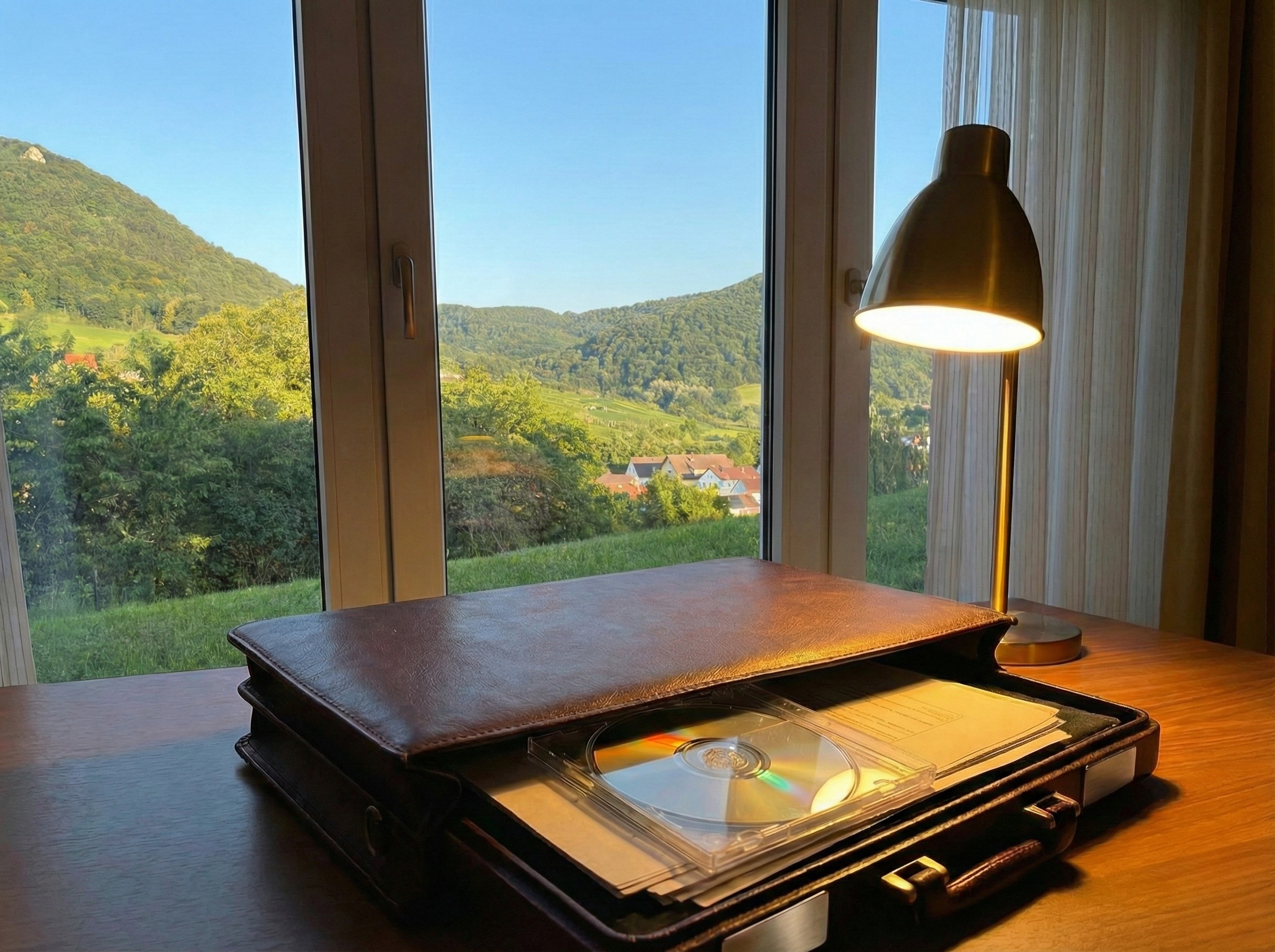

“I flew from Dubai to Singapore, always overnight, to kill the time. I’d get into Singapore at 5:00am get into the offices, and hand over the CD so my inbox could be rebuilt - I couldn’t start working until then. So, I’d have a shower, go off to meetings, and come back to my desk later that day to find my inbox recreated. Then I began my shift at the screen. One morning, the youngest IT guy was covering. He wasn’t familiar with protocol and very politely brought my disc back to me. It should have been destroyed, a new disc and a new inbox replacing it. I wasn’t at my desk yet. He put the disc inside a pocket in my briefcase and zipped the thing up. Back to Dubai I went. While I was going through passport immigration, the handle of my briefcase snapped, so I carried this briefcase - looking like I was carrying a baby - back into the country. I threw it in one of my wardrobes, and I didn’t see it again until the bank was in my rearview mirror, and I was in Germany.”
Post-Project Green. The fallout. Raising the red flag and identifying the massive exposure that Standard Chartered were operating under should have guaranteed Julian either a promotion, a raise or a big bonus at the end of the year. But a dismissal? That certainly wasn’t on his radar.
Diligence, being thorough, a bona fide expert in your field, to the benefit of your bosses and their bottom line. Not often does that result in a fall from professional grace. At this point, Julian’s previous life in London, with Man Group and Global Cool, couldn’t have felt more detached from his current reality. After all, it was this experience, and his former mentor’s relationship with the Abu Dhabi Investment Authority, that saw him pulled to the Middle East in the first place. They needed someone who knew the decision makers.
Brits, ex-pats, may well have sat at the bottom of the socioeconomic food chain in the Middle East during Julian’s tenure, but the stratification of its unequal and dual social structure ensured that wealth and the elite characters that took up much of his schedule lived well. In stark contrast, a substantial portion of the population was classified as poor or vulnerable to the point of poverty. It was this majority that Julian found himself to be more aligned with. There was empathy.
“They were wandering farmers, probably very sustainable farmers at that. I empathised with all of it. It wasn’t clear to me then that this is where my path would ultimately lead, but with retrospectivity, my work today reflects so many of those values, and the drive the people had to create something good in the face of conflict, challenge and change. At the time, in 2011 - the year leading up to my dismissal - I was travelling all around again - the Middle East, Africa, Asia - and then I settled into a regular working pattern to suit how many miles I was clocking up.
“I was given more and more to look at by the bank to maximise profitability. It was at this time that I stumbled upon a series of sundry accounts, piled full of money - all of this P&L of unallocated transactions that were all tagged as being bank-to-bank to get through the US system by Standard Chartered Bank Dubai TDFX Sundry. It’s an account name that wouldn’t have caused the regulators to look twice. It was a mechanism for evading the sanctions screening process.
“So, I compiled a report with a fix to increase the Bank’s profitability and bring it back in line with regulations; it could have caused so many problems if word got out. That was the start of me touring that report around the world to our teams in global offices. Little did I know that this was my swan song; it was my ‘goodbye’ to all the teams. While I was travelling, the Board were planning the best way to get rid of me.
“October 2011, I was in New York, the final stop on my farewell tour. I was asked to return to Dubai. It was a Sunday afternoon, and I was called in by the big boss.
“‘We heard you wanted to leave the bank?’ he said. And that was that. I was gone by November.
“My shares were cashed out at the highest value. I was given a $250,000 compensation package to go ‘happily’. They shipped our belongings to Germany, where we had a property and had chosen to relocate. And paid for us to take our maid with us, there was another year left on her contract. First class all the way. No expenses spared. They smoothed the path out for my ‘voluntary resignation’ and sent me all the evidence I’d need in that shipping container. I just didn’t know it yet.”
Germany had always been Julian’s second wife’s bolthole. It’s where she grew up and where she ran away from in her teenage years. Julian had bought a house there a year or so prior to his dismissal, in a gorgeous rural village on the edge of the Black Forest, that he fondly called Buzzard’s Eyrie. It was a house he loved. It reminded him of the home he grew up in in rural England, but rather magically blanketed in snow. So, it was the natural place to relocate after his forced resignation. It also happened to be home to one of his closest friends from training days in the RAF. A friend who would later work on deciphering the Billion Dollar Briefcase files, which were about to make their emergence.
“As I built the report that ended up sealing my departure from Standard Chartered, the analysis work took me far away from the Middle East in many ways, but I was still centred there - when you're running a 24-hour business and team, it’s without doubt the best place to sit on the planet. I was spending more and more time in Singapore, and whenever I travelled, because the data that I was analysing, as well as my team, was growing, I had my inbox given to me physically. On a CD, there was no cloud to put it in then.
“I flew from Dubai to Singapore, always overnight, to kill the time. I’d get into Singapore at 5:00am get into the offices, and hand over the CD so my inbox could be rebuilt - I couldn’t start working until then. So, I’d have a shower, then go off to meetings and come back to my desk later that day to find my inbox recreated. Then I began my shift at the screen.”
A simple change to the staff rota, a different face on duty, and Julian’s course was altered. His pattern interrupted. His entire future as the universe delivered a message.
“One morning, the youngest IT guy was covering. He wasn't familiar with what to do and very politely brought my disc back to me. But that certainly wasn’t protocol. It should have been destroyed, a new disc and a new inbox replacing it. I wasn't at my desk yet, but my briefcase was. He put the disc inside a pocket in my briefcase and zipped the thing up. I wasn’t really in the habit of using my briefcase; it was more like a symbol to me at this point. A memento of my career transition that had toured the world with me. So, I went back to Dubai. On the way back in, while I was going through passport immigration, the handle snapped, so I had to carry this briefcase - looking like I was carrying a baby - back into the country. I threw it in one of my wardrobes, and I didn't see it again until the bank was in my rearview mirror, and I was in Germany.
“Shortly after we had settled in Germany in 2012, a shipping container of our belongings arrived, remember the one that Standard Chartered had shipped over free of charge? Out spilt the boxes, all over my lawn in the middle of southern Germany. And among the fragments of our life in the Middle East was my beloved briefcase. Handle still broken, and that pocket still concealing a CD that held all of the secrets being harboured in my inbox.”
Julian describes the family’s years in Germany as ‘a good time’. He worked on a waste reduction project that resulted in the production of a natural fertiliser of sorts - a business founded in Switzerland, named ‘Soil and More’. A precursor to what, ten years down the line, would become his true passion project in Fairman Knight & Sons.
Diary Entry
An Introduction to Danny
2025 | Holbeach, Lincolnshire
“I'd met Danny Alter in 2012, after the briefcase reemerged, after I rediscovered the disc. I had gone over to America with the CD. I could see exactly what he was, one of these brilliant humans. Very sincere. Very credible. Very trustworthy.
“General counsel for our businesses today, as well as The Billion Dollar Briecase, in over three decades as a practising lawyer, Danny has explored both the public and private sectors, served as an Assistant U.S. Attorney for the Southern District of New York (as Acting and Deputy Chief of the Civil Division), Senior Advisor and Special Counsel to the New York State Attorney General, and General Counsel to the New York State Department of Financial Services (DFS).
A former adjunct professor and senior fellow at New York University Law School, Danny was a resident member of the law faculty research and teaching program from 2015-17, specialising in corporate compliance and enforcement, and focusing on financial services regulation. Prior to this, he was selected by the New York State Commission on Judicial Nomination as one of seven candidates statewide for a seat on New York’s highest court, the Court of Appeals. A litigator at every level of US federal and New York State courts, Danny has been privy to influencing important issues of constitutional, commercial, communications, banking, trusts and estates, and bankruptcy law. He is as clever as they come, and a good soul to the core.
“But Danny's story is a tale of its own. Outside of his credentials that read like a Harvard grad’s dream CV, the Biden and Obama administrations basically stifled his career and prevented him from being a judge. The only openly gay candidate as a judge in the New York circuit, there’s no denying he's had his own challenges. He was responsible for issuing two of the largest fines ever seen brought against a bank - the first being Standard Chartered and the second being BNP, which received one of the world’s biggest fines. His time in the legal world also saw him become one of the most effective prosecutors in his former role at the United States District Court for the Southern District of New York (SDNY).
“A turn of events coated in irony, not only did Danny know that department inside out, but the same department would end up at the epicentre of the Billion Dollar Briefcase US court proceedings. Since day one, Danny has been absolutely, utterly convinced of the bank’s wrongdoing. He saw it firsthand in the form of that dusty briefcase. He saw it in the form of all the evidence that we brought in. He could just see this wall of deceit that the bank had constructed, and helped us tear it down as we've gone through the decloaking process. I knew that we’d become good friends. It took probably the best part of 10 years to achieve it, but he's part of us now.”