The Keys to the Kingdom
Lured back into finance by a project developing SCB’s Water Policy, Julian landed in Singapore with full access to the Bank’s digital network. Keys to the kingdom that led him to ‘Project Green’. What he thought was an environmental endeavour was, in reality, a shadowy operation linked to high-ranking officials, run out of Dubai, with accounts linked to Iran. What was Project Green? Why did asking this question prompt Julian’s dismissal? And how did his second wife’s actions lead to Julian uncovering what would collapse this house of cards?

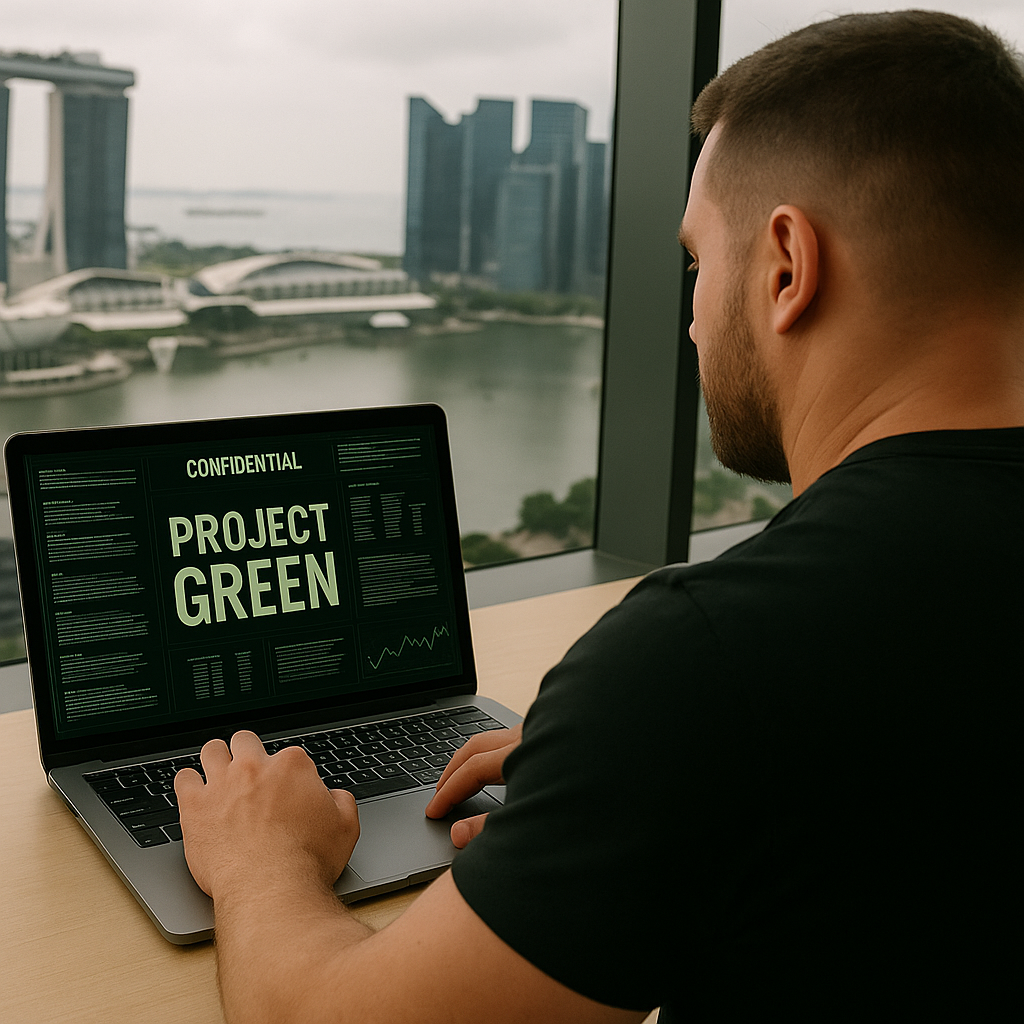
“After the eye-opening night of the gala, I began my work at Standard Chartered. I was in Singapore writing the Water Policy for the Bank, a 6-month project that would ultimately affect the Bank’s clients and their business, as it was closely linked to their private equity ambitions. I arrived with my own laptop and was quickly wired into the Bank’s intranet. It was a connection that gave me an imperious view of the Bank. While I was searching for a colleague I was due to meet regarding water, I came across Project Green. I stupidly assumed it was a green, environmental endeavour. But, as I looked closer, it was full of details concerning trade commissioners and high-ranking officials. Digging deeper, it appeared to be run out of the Dubai office by a Trade Finance expert. I took note of all of it, but it wasn’t until I was transferred to Dubai in 2009, the Bank’s new Global Head of Transaction Banking FX, that Project Green reared its head again. “What’s Project Green?” I asked. Access denied. And then the house of cards started coming down.”
“What job do you want?” It was certainly a dangling carrot. On the other end? One of the world’s most highly profitable, leading international banks. But leaving Global Cool wasn’t, in all honesty, something Julian wanted to do. Time and time again, conversation after conversation, the Bank Chairman was told the only way to get Julian back into banking was with a steak, not a carrot. A meaty project that supported the environment. With two feet down in the world of carbon and sustainable businesses through Global Cool’s projects, as it turned out, in the end, it was water, not a prime steak, that lured Julian back to banking.
It was ground that hadn’t been trodden by investment banking before, and there was no denying that this project on water-stressed areas presented Julian with a golden opportunity, packaged up with a bow and a timely move to Singapore. It was also a relocation that would allow him to still the waters at home, with his second wife wanting a swift move away from London.
Seconded to operate out of Strategy, a department working out of the Bank’s Singapore office, Julian headed up to new office digs in Battery Road skyrise - a skyscraper located in the city's Central Business District that was at the time known as the Standard Chartered Bank Building.
He was facing the hearty challenge of creating SCB’s first Water Policy, and so, over the next 6 months, Julian mapped out how water stress would affect the Bank’s clients and, more importantly, their business. It was a project closely linked to their private equity ambitions, with the Bank having a private equity fund that was already busy acquiring water treatment businesses. All eyes were on Julian.
Immersed in Strategy, the mergers and acquisitions hub of the bank, the high-level corporate world once again became Julian’s bread and butter. Working on his own laptop, Julian was plugged into the Bank’s intranet via an external modem. Once online and logged in, Julian had full access to the Bank’s digital network. Bizarre when you consider he was initially only hired to complete a six-month contract as a consultant.
It was business as usual until Project Green came across Julian’s desk. An uneasy feeling settled in Julian’s gut.
“Hang on, why is that guy changing that account name?”
“Why have we got all these sundry accounts floating around? This one’s got nearly a billion dollars of P&L in it, and no one’s accounting for it?”
“Why is this not attributed?”
“Why can these guys log on from Iran, and the system doesn’t show where they are?”
Digging deeper, Project Green appeared to be run out of the Dubai office by a Trade Finance expert. It was something he would need to raise with the team over there. But news of Julian’s relocation to Singapore soon spread, and his former foreign exchange (FX) network sought him out, in an attempt to lure him back onto the trading floor. Project Green had to wait.
A career niche that spanned a decade of Julian’s history, stints at the likes of NM Rothschild and Sons and Fimat International Banque earned Julian his FX stripes, and ironically seemed to seal his fate at SCB. Following an invite to meet the SCB FX team, the support Julian could offer that department wasn’t lost on the Bank.
Boxing Day 2008, and he was offered the role of Head of FX, and the cogs of travel started turning once again, as Julian and his family left Singapore behind and headed to the desert.
Following Julian’s arrival in Dubai and on to the FX team, the good job he had done on the water policy had set a precedent, and a promotion didn’t take long; Global Head of Transaction Banking FX, a title so long that Julian’s peers joked it should go on a diet.
As he was finding out with SCB, there was an ulterior motive to his step up on the corporate ladder; Julian’s relationships with the Abu Dhabi Investment Authority, a legacy from his time at Man Group and Global Cool. They needed someone who knew the decision makers.
Months and months passed by. More and more responsibility was piled on. More and more system access was granted. No questions asked; Julian was given the keys to the kingdom. Working to maximise any potential for the Bank when it came to FX opportunities, any initial rumblings of professional excitement were soon quelled as Project Green came across his desk once again.
At the scale SCB was operating at, everything had to have a data trail. Of course. It was, and still is, a compliance requirement of the highest level. The Bank had to be kept accountable. So, why were the records in Project Green accessible to people in Iran, and even more imperatively, why was that access not being tracked?
Alarm bells rang - Julian’s RAF training guaranteed that. This was big. Even from Julian’s position at the time, naive to what was yet to unfold, these discrepancies could have significantly changed the bank’s reported profits if word got out. As the new kid on the block and one who was seen to have the ear of the Deputy CEO, CEO, and Chairman, for that matter, Julian’s challenge was to fix it.
The irony of this endeavour was that Standard Chartered had put Julian in this position and led him straight to a closet full of skeletons. He was the Foreign Exchange guy, brought in to maximise the potential of the Bank and its clients, not kill the golden goose.
All efforts to fix the issues he had uncovered resulted in a volatile chain reaction. Julian’s findings and reports pointed out the red flags and the lack of anti-money laundering provisions to his seniors. Asking the simple question, ‘What is Project Green?’ found him on the unexpected end of a dismissal. They wanted him out.
Diary Entry
Everything happens for a reason
2025 | Lincolnshire
“As with so many aspects of your life, certain factors you can only truly understand retrospectively. Had I not been part of Standard Chartered, I would not have stumbled upon Project Green in Singapore and then gone to Dubai to investigate it further, or later discovered the disc and evidence of SCB’s violations. Looking back, it was my second wife who took me on the journey. It was torrid and volatile. A journey that took me away from my family, destroying it for a long time, centered around her materialistic need for more.
“After we had married, my second wife bombed my family apart. I had two children from my first marriage, which she was aware of, of course, but she controlled my relationship with them to the point that I had none. It totally fell apart. The move to Singapore, taking me physically away from them, was to satisfy her need to leave London, and then to Dubai to leave Singapore.”
Julian’s years with his second wife, and the stories that come from that time in his life, are laced with chaos. A fairly intemperate and unpredictable character, her fuse was short and her temper was quick. And while Julian has mused that this explosive nature could, in fact, have been used to mask what, unbeknownst to him, was going on outside of their marriage in its last few years, her Iranian heritage, the values she was raised to believe in, also contributed to the events that would unfold over their time together.
“My second wife’s grandmother, by birth, was from Persia, and religiously inclined and aligned to that area of the world. Generations of her family were very much of the view that an action should be equalled - if someone wronged you, they were to be wronged back.
“When we first met, my second wife was a very far-flung version of the person she ended up unravelling to be, but it was all already there, the bits that made up that person. The seeds were already there. She was a person who was very much living under a veneer, in the middle of her own self-made meltdown.”
Even after relocating to Lincolnshire, yet another move fueled by his second wife’s erratic behaviour and founded on the hope that this setting would provide a calmer environment where they could turn the gas down on everything that had been going on, the reality was quite the opposite of the intention. Her alcohol use increased, escalating to drug use and numerous affairs. Always destined for collapse, once Julian got wind of the affairs, the process of separation began. A path that would threaten Julian’s life in more ways than one.