Fast Jets and Finance
The first in a series of explosive teasers from the forthcoming book, The Billion Dollar Briefcase, this instalment will take you back in time to experience Julian's adrenaline-fuelled life as a pilot, and the shocking moment he uncovered evidence detailing the funding of terrorist groups and the supply of weapons to conflict zones. Prepare for a real-life story of profound ethical collision, where a former serviceman who left 'the fight' is pulled back into a battle for truth, exposing the devastating link between global finance and global terror.

“What we found in 2023 was frightening. When you start seeing the names of leading participants in Hezbollah, Hamas, and generals in the IRGC…evidence that details the financing of munitions, down to the fertiliser used in IED bombs that killed so many of our servicemen, as well as the companies responsible for manufacturing the missiles that have been sent to Ukraine to destroy the Ukrainian people. Realising the sheer scale of this operation…Connecting the dots…it was shocking. It made my head spin, especially because I had joined the bank back in 2008, feeling that this institution was a real force for good. I had completely bought into the image the bank had painted of itself. Finding this hidden network of illicit activity, sitting right there in those Excel sheets, was a profound betrayal of everything I thought I was part of.”
Having been in the city (of London) for quite some time before taking on the CEO and Chairman role at Global Cool, a role which ultimately piqued the interest of Standard Chartered Bank chairman, Lord Mervyn Davies, Julian’s initial foray into finance was a stepping stone away from the military world. A career path traversing numerous industries, albeit with uncanny parallels, this is a journey that has been littered with irony and saw the pilot-turned-financier-turned-philanthropist turn away from ‘the fight’ only to be pulled back into the thick of it once again.
After surpassing all set precedents and being accepted into the RAF in 1988 with situs inversus - a congenital condition that sees people born with their internal organs arranged in a mirror image of their normal positions - Julian continued to defy all odds, attaining the rank of Flight Lieutenant with No. 79 (Fighter) Squadron flying the Tucano T mk1 and BAE Hawk T mk 1A.
Training and live operations saw him hone an incredible skill set, ranging from the art of warfare and in-air combat to survival skills that guaranteed his quick actions and mediation in ambush and terror situations.
Diary Entry
RAF Tucano sortie
May 1993 | RAF Linton-on-Ouse
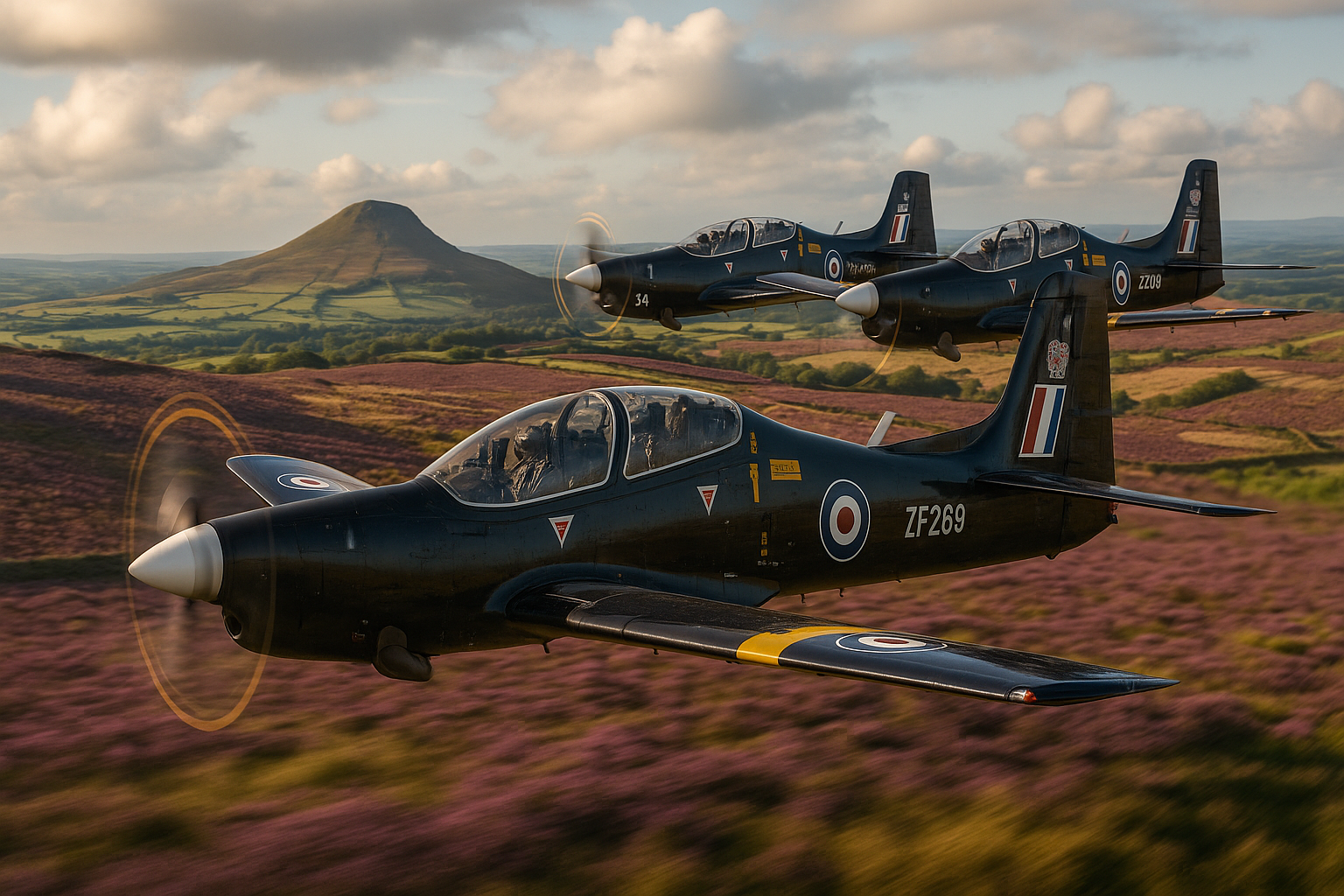
“Amid rolling fields and under often capricious North Sea weather, the sprawling Yorkshire airfield nestled. I, a 22-year-old solo student pilot in the Advanced Basic Flying Training School (BFTS) syllabus, faced one of my most demanding sorties: leading a three-ship formation in the black-painted Shorts Tucano T Mk 1.
“The Tucano, a licence-built derivative of the Brazilian Embraer EMB 312 with its single Garrett Air Research TPE331-12 turboprop engine delivering 1,100 shaft horsepower, was a forgiving yet unforgiving trainer - low-wing, tandem two-seater with a 33-foot wingspan, 29-foot length, and a top speed of 385 knots, but aerobatic and capable of low-level ops down to 250 feet above ground level (AGL). Painted in the standard black scheme for night and low-vis training, our three aircraft - me as lead in the front seat of No. 1, with wingmen in Nos. 2 and 3 - were tasked with practicing combat formations at low level over the Yorkshire Moors and low-flying areas like the Yorkshire Dales. This sortie tested leadership, energy management, and tactical awareness, simulating beautifully fast-jet ops where a single error could spell disaster in formation integrity or collision.
“The briefing room buzzed with tension that morning, the chalkboard scribbled with diagrams of formations: finger-four for mutual support, line-abreast for visual sweeps, echelon left/right for attack setups, and combat spread for evasion drills. My instructor, Flight Lieutenant Colin Marchbank, a veteran with 3,000 hours on Jaguars and prior Hawk time, emphasised the lead’s responsibility: “You’re the eyes for the formation, Knight. Maintain 300 knots, 500 feet AGL, scan for traffic and terrain - Yorkshire’s hills don’t forgive.”
“The Tucano’s cockpit was a compact haven of analogue gauges - Garrett TPE331-inspired avionics with HUD for simulated weapons, Martin Baker ejection seats yet retrofitted with stab knives to push the canopy apart, so survival hinged on skill. Strapping in, I felt the Nomex flight suit’s familiar squeeze, oxygen mask clipped, helmet’s HUD aligned. The pre-flight checks were ritual: engine start with the TPE331 spooling to 100% N1 in seconds, its 1,100 shp whine building to a throaty roar; flaps checked, trim set neutral, radios tuned to the BFTS tower at 118.5 MHz.
“Taxiing out on the concrete runway 03/21, the Tucano’s tricycle gear bumped over seams, wingtips 10 feet from my wingmen’s as we formed up in trail for takeoff. As lead, I called “Formation takeoff, ready,” and we rolled - brakes released, throttled to 80% torque, accelerating to 80 knots rotation - being careful to remember the “ball” - the rudder trim. The Tucano lifted smoothly at 90 knots, gear up at 100, climbing in echelon right at 120 knots, flaps retracting with a hydraulic whine. At 2,000 feet, we turned northwest toward the low-flying area, descending to 500 feet AGL over the undulating moors, ground rush blurring sheep and stone walls below. My heart rate spiked - leading solo meant no dual instruction; I had to verbalise manoeuvrers while keeping station precise, wingtips locked at 5 feet separation.
“First formation: finger-four, spreading from trail into a loose diamond for 360-degree coverage. “No. 2, go left echelon; No. 3, right,” I radioed, banking gently left at 300 knots, the G-forces mild at 2G but demanding precise aileron input on the Tucano’s responsive controls. The Garrett TPE331 engine’s torque pulled us through turns, altimeter hovering at 500 feet as we skimmed heather-clad hills. Energy management was key - avoid bleeding speed in climbs, using the prop’s fine pitch for quick acceleration. Wingman No. 2, a fellow student, wobbled slightly, forcing me to adjust the throttle to match; “Tighten it up, No. 2 - visual on you.” Transition to line-abreast: “Formation, line-abreast,” pulling up to 1,000 feet for a simulated sweep, wings level, scanning for “bogeys” (other students or instructors). The Tucano’s visibility was superb from the front seat, but low-level demanded constant terrain avoidance - Yorkshire’s valleys funneled wind, gusting to 20 knots, testing stability.
“The crux: combat spread from echelon, breaking into spread for “defensive” manoeuvrers. “Break right, combat spread!” I commanded, yanking the stick for a 3G turn, No. 2 breaking inside my turn, No. 3 outside, forming a loose V at 1,000 feet separation. Simulating a threat, we practiced scissors - crossing paths in a head-on pass at 400 knots closing, then rolling into vertical scissors, pulling 4G to reverse roles. Sweat beaded under my helmet; the Tucano’s low stall speed (80 knots clean) allowed aggressive manoeuvrers, but at low-level, a botched recovery could mean ground impact. “No. 3, overshoot - rejoin,” I barked as a wingman lagged, the radio crackling with brevity code. Fuel state at 1,500 pounds, we pushed to the briefed divert if needed - Topcliffe - but pressed on, reforming echelon for a low-level transit back, skimming at 250 feet over the Vale of York, engine’s prop blur a constant hum.
“Debrief at Linton was brutal: video replay showed my lead turn too aggressive, risking No. 2’s separation, but Hargreaves nodded, “Solid leadership, Knight - pass”. That sortie forged my resilience, a solo command echoing the squadron motto, much like the betrayals I’d face later in banking. The Tucano’s black paint faded in the May sun as we shut down, but the lesson in fighting formation trust lingered, a foundation for the high-stakes manoeuvrers of life beyond the cockpit.
“A week after this sortie on a Sunday evening, my Squadron Commander called me in the Officers' Mess after the base had received news about my Mother, who was very poorly in a Nottingham Hospital. I was told I should go there immediately. But, walking into the ward, I found her lifeless. She had succumbed to a highly aggressive cancer and could fight no further. As it turned out, my fight was just beginning.”
The weeks and months that followed rippled with a strange combination of grief and the euphoria of passing his leadership sortie. Forced into the Hold - an enforced delay in his training - Julian had to wait, with breath bated and grief playing out, for his next posting. A process that effectively started to curtail his RAF career before it had even begun. With a torturous three years to pass before he could return to the skies, Julian turned his attention to plan B. After completing an MA at Nottingham University, the Flt Lt explored what else was out there; a journey that was destined to put the Billion Dollar Briefcase in the palm of his hand. After all, the briefcase itself was a gift from his father, welcoming him to the dizzying world of FX Trading and Environmental Finance.
Having been at Global Cool, working with luminaries of the climate change movement to make genuine positive change, Julian’s move to Standard Chartered Bank was a move founded on the best of intentions. It was a move that set Julian out on a different path, one which began in earnest at Standard Chartered Bank’s ‘Seeing is Believing Gala Dinner' in New York, 2008. Surrounded by New York’s elite in the ballroom at the Mandarin Oriental Hotel, the evening was a stark juxtaposition of the polarised social economy that the world was facing. Soaked in opulence, black ties waddled around like fat penguins, slick with greed, in the middle of the financial crisis, while pandemonium ran rampant across the world.