Resistance to Interrogation
In this pivotal chapter, Julian recounts a gruelling eight-hour interrogation that took place in Manhattan, January 2013. An experience that eerily echoed the fight or flight conditions of his resistance-to-interrogation training in the RAF, this meeting served as the trigger point for investigators. While federal agents and SDNY prosecutors accused him of lying, the world outside was locked in a high-stakes game of financial warfare. From the ‘Sovereign District’ of New York to the frantic halls of the UK Parliament, discover how Julian’s interview unfolded, the first domino to fall as the true battle against Standard Chartered began.
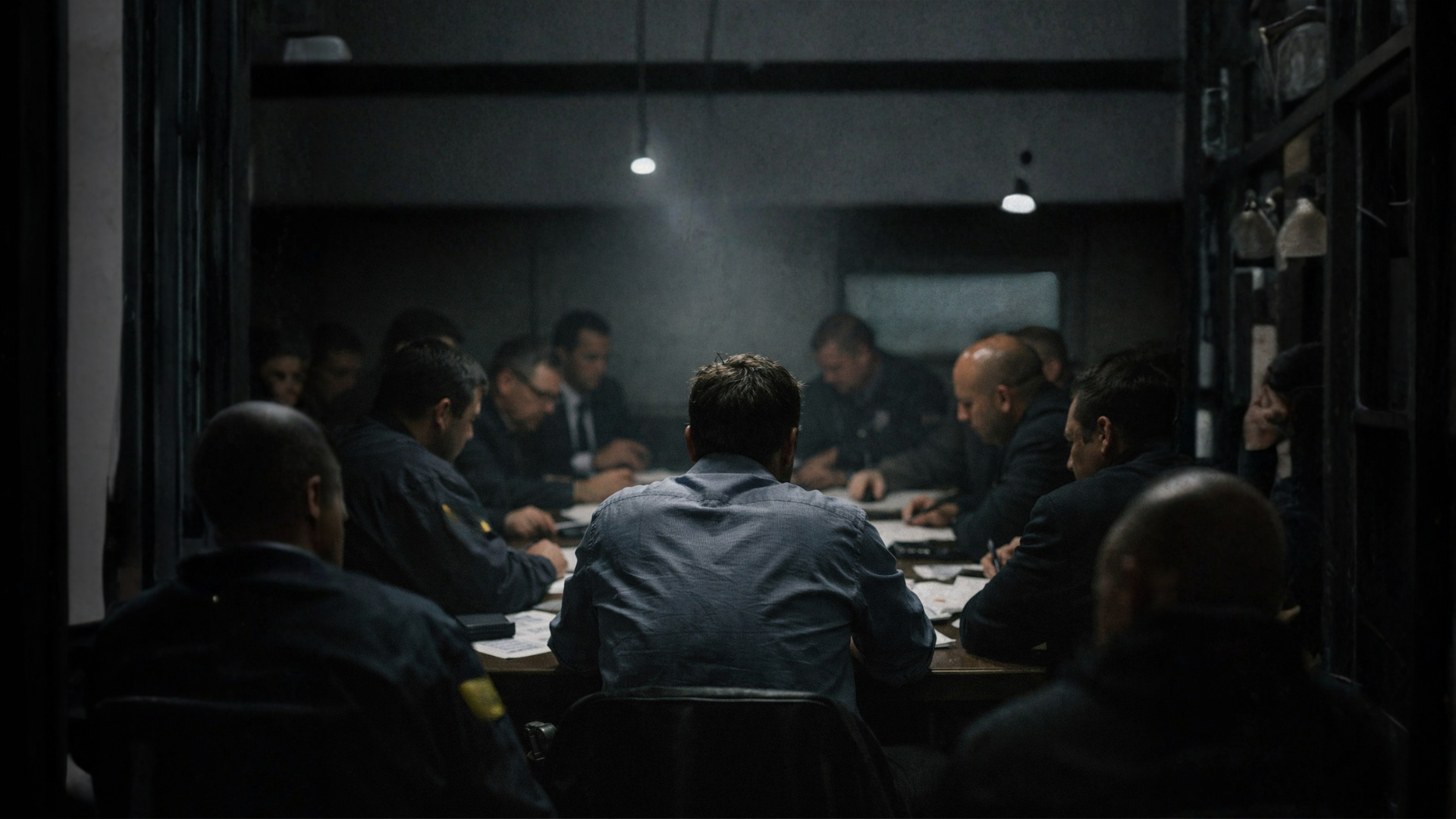
“When I underwent resistance-to-interrogation training in the RAF, we were waterboarded. A dirty sandbag over the head. Forced into freezing Northumbrian streams. A boot pressed down until panic took over, and instinct screamed. The lesson wasn’t pain - it was endurance. How the body reacts when time stretches, when there is no relief, no reassurance, no clock you can see. I never imagined that skillset would be relevant again. Not twenty years later. Not in a windowless room in Lower Manhattan. And not at the hands of people who believed they were on the right side of the law.
“2013. I’m called over to a wet, cold New York from Germany. I spend a couple of days in the city, but the majority of my stay is taken up by one unforgettable interview. The trigger point. There are 40, maybe 50 people in that room. No phones. No friendly faces. The FBI is there; they are armed. The guys from DC are there, too. The set-up feels incredibly military, more like an interrogation. Jean-David Barnea is leading the interview. Assistant United States Attorney (AUSA) in the U.S. Attorney’s Office for the Southern District of New York (SDNY), he was responsible for managing the case.
“I’m on their territory, and this meeting is the dawning, the realisation, of what’s actually been going on. What they’ve missed. From the moment I walked in, you could see hostility from every man and woman around that table. Collectively, they had missed Dubai; they had no idea what was going on behind closed doors and how it was being put together. It got pretty hostile. No water. No coffee. No break. Just relentless questioning.”
Before the container of Julian’s belongings spilt across the lawn at Buzzard’s Eyrie, before the evidence was found, before Julian had crossed Danny Alter’s path, Danny had been fighting the same corner for years already.
As the General Counsel for the New York State Department of Financial Services (DFS) in 2012, Danny became known as the legal mastermind behind the legal strategy that led to Standard Chartered Bank being fined for violating US sanctions, particularly those related to Iran, and the subsequent settlement.
“When you’re a bank going into these regulatory meetings, you want to try and go in open book so you get everything ‘dirty’ dealt with at once, rather than it lingering,” explained Julian. “Danny sensed that Standard Chartered wasn’t airing all of its laundry, even back then. He put a Deferred Prosecution Agreement (DPA) on them.”
Fast-forward to 2013. Julian was on the verge of leaving Germany to return to US soil and the banking world. It was the year that the disc’s existence became known. The year that Standard Chartered realised unwanted eyes were looking into hard evidence that documented its unlawful activity, proof that they had consciously continued to evade sanctions in the Middle East and fund terror groups.
It was a year that began with Julian being called into the first formal interview linked to the case, a direct result of the disc coming to light, held in Manhattan under the administration of the Southern District of New York (SDNY). An unusual culture within itself, SDNY seemed to protect its own regardless of policy, including knowingly sitting on false declarations.
“It’s a wet, cold January in New York. I'm called over, flying in from Germany. I spend a couple of days in the city, meeting with Danny and his multi-stakeholder team, but the majority of my stay is taken up with this interview. We’re down in the bottom of Manhattan, just off Water Street, down near Foley Street, where the civil court is.
“There are 40, maybe 50 people in that room. No phones. No friendly faces. No Danny. The FBI is there; they are armed. The guys from DC are there, too. The set-up feels incredibly military, more like an interrogation. Jean-David Barnea is leading the interview. Assistant United States Attorney (AUSA) in the U.S. Attorney’s Office for the Southern District of New York (SDNY), he was responsible for managing the case.
“I’m on their territory, and this meeting is the dawning, the realisation, of what’s actually been going on. What they’ve missed. From the moment I walked in, you could see hostility from every man and woman around that table. While our evidence exists, at this point, we don’t have all the forensic analysis we need. What we do have is the top face proving there are more Iranian deals than the Bank has acknowledged and taken responsibility for already. We’d highlighted to their superiors that they hadn’t done their jobs properly. The atmosphere was very adversarial. And it continued for 8 hours.
“There’s no hint that any of them knew a thing about what had been going on in the Middle East. That Dubai was sitting at the epicentre of all that evil. But in that room, no one wanted to admit that. They’re all sitting there shoulder-to-shoulder with their bosses, bosses at agencies that should have been aware of what was going on. The DC guys had been tasked with investigating it already.
“As the hours ticked by, the biggest and most vocal critiques were coming from a guy called George Varghese. A representative of the Department of Justice from Washington DC, part of the team that was supposed to have been investigating already. At one point during the interrogation, he threw his pen down and screamed at me, “But you’re lying. You must be lying”. To be accused directly to your face that you’re a liar is very aggressive, but for me, it turned out to be a very poignant moment. It was the last thing I had expected to hear from these guys.
“When you are coming at the situation from a position of complete truth, you don’t expect to be told you’re a liar. They had missed Dubai; they had no idea what was going on behind closed doors and how it was being put together. As George got braver, more and more of the group fired questions at me. It got pretty hostile. I lost my voice; I was talking so much. No water. No coffee. No break. Just relentless questioning.
“Which is why what followed was so surprising. Denial turned to action. All of a sudden, subpoenas were being written, and literally what seemed like 20 truckloads of information were being requested by Barnea, “we don't believe the Bank, we’re throwing the book at them”, and here started the investigation.
“That all began in February 2013. Less than a month after the meeting in Manhattan, all of my ‘lies’ had somehow influenced a full investigation being launched. Initially, I was searching just to find the truth. But this picture was much bigger than so many anticipated. Standard Chartered had wiped all information from its servers in Dubai, of course. In the disc, I was handing over a Grade A strike on the Bank to support Barnea’s investigation. It was the only surviving hard evidence, and what we were presenting was the trigger point for that. And what we were presenting was the tip of the iceberg.
“It was at this time, February to March (when subpoenas are flying about) that the Bank sends in a 50-page report showing the state of the nation, and allegedly what they’d been doing in Iran. The report painted a pretty picture: ‘Yes, there was a problem during that time, but we wound it all down, and we stopped; then nothing else happened’. But no one was admitting what was going on to the fullest extent.
“It’s all wind-down, wind-down, wind-down. The Bank reinventing the wheel. We might have had the disc, but we didn’t have granular transactions yet. We just had big doses of P&L when P&L shouldn’t have been made. The Bank maintained that these transactions were all part of a wind-down (which is exactly what should have followed the 2012 sanctions brought against Standard Chartered by Danny). Close-down transactions that are completed very much as a compliance exercise, a client wind-down is an incredibly scrutinised process done to serve a very important purpose: to close a client’s account that’s already been frozen. The account is chopped, all funds are returned to the legacy currency, and you shut it down. You hold the currencies; you don’t give them back when a client is sanctioned.
“We kept looking, deeper and deeper, pushing the bank a bit harder. It grows into a battle between the bank, which should by all accounts be behind bars and not being served any grace from the United States, and the regulators who have egg on their faces.
“It goes back and forth, but towards the end of March 2013, one of the senior leadership team from the UAE is interviewed in London by regulators. They’re shown a report, evidence, and my name hasn't been redacted. All of a sudden, the penny drops at Standard Chartered, and the whistleblower is outed for the first time.”
Diary Entry
The World Outside was a Perfect Storm
2025 | Holbeach
“The beauty of hindsight really is an amazing thing. When I underwent resistance-to-interrogation training in the RAF, we were waterboarded. A dirty sandbag over the head. Forced into freezing Northumbrian streams. A boot pressed down until panic took over, and instinct screamed. The lesson wasn’t pain - it was endurance. How the body reacts when time stretches, when there is no relief, no reassurance, no clock you can see.
“I never imagined that skillset would be relevant again. Not twenty years later. Not in a windowless room in Lower Manhattan. And not at the hands of people who believed they were on the right side of the law. I was caught in the gears of a global machine that didn’t want to be interrupted.
“In that room, the air was thick with a very specific brand of tension. I was sitting at the fault line between the SDNY (the Southern District of New York) and the Department of Justice guys from DC. The ‘Sovereign District’ vs. The Beltway.
“To the SDNY and the men across from me, the likes of George Varghese and Jean-David Barnea, I was a complication. While the DC guys felt embarrassed, they had been ‘scooped’ by a state regulator. Now, I was standing there telling them, showing them even, that that “historic” settlement was a sham, that the bank was still running money through Dubai. You can almost see the cogs turning, ‘If he’s right, we haven’t just been scooped; they had been played’.
“Outside those doors, the Obama administration was in the White House, engaged in a high-stakes game of 'financial attrition' with Tehran. The White House wasn’t using missiles; they were using the US Dollar. They had just signed the Iran Threat Reduction Act, designed to choke off every last cent of Iranian oil money.
“I knew what they didn’t want to admit: Dubai was the leak in their bucket. Standard Chartered’s Dubai branch sat at the epicentre of it all. While the FBI agents in the room glared at me, and the US Treasury was trying to maintain a global embargo, I was holding a disc that proved one of the West’s biggest banks was effectively helping the other side.
“Perhaps the most surreal part of being 'outed' and interrogated was the silence of the British Government. While I was being told I was a ‘liar’ in Manhattan, the ‘Special Relationship’ between the UK and the US was being tested.
“Back in London, George Osborne, the Chancellor of the Exchequer, was reportedly making frantic calls to the US Treasury. The narrative in Parliament was that New York regulators were ‘bullying’ British banks. The UK was still reeling from the 2008 crash; they were terrified that if the US threw the book at Standard Chartered - as Barnea eventually threatened to do after my interview - it would have the potential to destabilise the City of London.”